WiseGold Weekly Pulse | March 06, 2026
Coverage Period: February 27, 2026 (00:00:00 EST) to March 06, 2026 (11:00:00 EST)
Executive Summary
The past week was characterized by a sharp escalation in geopolitical risk, notably the US-Israel strike campaign in Iran, which triggered a significant flight to safety across global markets. This geopolitical shock overshadowed mixed macroeconomic data, driving crude oil prices sharply higher and prompting a substantial rally in US Treasuries. Inflation concerns remain elevated, as evidenced by stronger-than-expected US Producer Price Index (PPI) data and persistent price pressures noted in global PMI surveys. Central banks, including the Federal Reserve and the European Central Bank, maintained cautious stances, balancing the risks of sticky inflation against the potential economic fallout from the Middle East conflict. In this environment of heightened uncertainty and market volatility, precious metals, particularly gold, continued to demonstrate their strategic value as safe-haven assets, supported by ongoing central bank purchases and renewed ETF inflows.
Key Takeaways:
- Geopolitical Shock: Escalating Middle East conflict drove a flight to safety and halted Strait of Hormuz tanker traffic.
- Inflation Persistence: Stronger US PPI and global PMI price indices underscore sticky inflation risks.
- Treasury Rally: US 10-year yields fell below 4% as investors sought refuge from equity market volatility.
- Energy Surge: WTI and Brent crude prices spiked significantly due to supply disruption fears.
- Gold Resilience: Gold prices remained robust amidst safe-haven demand and continued central bank accumulation.
Market & Macro Week-in-Review Timeline
- Fri Feb 27: US January PPI data released, showing stronger-than-expected increases in both headline (0.5%) and core (0.8%) readings, fueling inflation anxieties [1]. US 2-year Treasury yield stood at 3.38%, and the 10-year yield at 3.97% [2].
- Sat Feb 28: Major escalation in the Middle East as US and Israeli forces launched a strike campaign into Iran, prompting retaliatory missile attacks and a halt in tanker traffic through the Strait of Hormuz [3] [4].
- Mon Mar 2: Global manufacturing PMI data released; US ISM Manufacturing PMI registered 52.4%, indicating continued expansion but with intensifying price pressures [5]. Platinum prices reached a high of $2,428.48/oz [6].
- Tue Mar 3: Federal Reserve Vice Chair for Supervision Michelle W. Bowman delivered a speech emphasizing liquidity resiliency and financial stability [7]. Platinum prices experienced volatility, dropping to a low of $1,994.18/oz [6].
- Wed Mar 4: The Federal Reserve released the Beige Book, providing an informal review of current economic conditions [7]. The WSJ Dollar Index fell 0.28% to 95.58, marking its largest one-day decline since early February [8].
- Thu Mar 5: A FEDS Note highlighted how tariffs gradually raised retail prices in 2025, adding to the discourse on inflation drivers [7]. Initial jobless claims remained unchanged at 213,000 for the week ending February 28 [9].
- Fri Mar 6: Gold spot price reached $5,151.40/oz, while WTI crude oil surged to $88.30/barrel and Brent to $91.49/barrel [10] [11]. (10:00) Market pricing suggests continued focus on geopolitical developments and their impact on energy and inflation.
Thematic Deep Dives
Macro & Monetary Policy
Central banks remain in a delicate balancing act, weighing persistent inflation against emerging geopolitical risks. The Federal Reserve’s recent communications, including the Beige Book and speeches by key officials, underscore a focus on financial stability and a cautious approach to potential rate cuts, given the current federal funds rate of 3.5% — 3.75% [7] [12]. The European Central Bank (ECB) and the Bank of England (BoE) similarly highlighted the inflationary risks posed by the Middle East conflict, with the BoE holding rates at 3.75% [13].
- Fed balance sheet growth continues with $40 billion/month in T-bills until mid-April [14].
- ECB officials warned that an extended Middle East conflict could push up inflation [13].
- BoJ Deputy Governor noted Japan’s inflation rate has not definitively reached the 2% target [13].
The divergence in central bank policies is becoming more pronounced as regional economic conditions vary. While the Fed and BoE maintain relatively high rates to combat sticky inflation, the BoJ remains accommodative, highlighting the complex global monetary landscape.
Inflation & Growth Data
Recent data presents a mixed picture of the US economy, with robust growth accompanied by stubborn inflation. The advance estimate for Q4 2025 real GDP showed a 1.4% annual rate increase, contributing to a 2.2% increase for the full year [15]. However, inflation metrics, particularly the January PPI, exceeded expectations, with core wholesale prices accelerating by 3.6% for the full year [1].
- US CPI (all items) increased 2.4% year-over-year in January 2026 [16].
- US PCE price index increased 2.9% in Q4 2025 [15].
- Eurozone HCOB Manufacturing PMI reached a 44-month high of 50.8 in February [17].
The persistence of inflation, particularly in the services sector and driven by recent tariff increases, complicates the outlook for monetary easing. The divergence between manufacturing expansion in the US and Eurozone versus contraction in China further highlights uneven global growth dynamics.
Rates & Yield Curve Dynamics
The US bond market experienced a significant rally, driven by a flight to safety amidst escalating geopolitical tensions and equity market volatility. Short-term yields reached their lowest levels since 2022, with the 2-year Treasury yield dropping to 3.38% and the 10-year yield falling below 4% to 3.97% [2].
- The 2-year/10-year Treasury spread narrowed slightly to 0.59% [2].
- A Bloomberg index of Treasuries returned 1.5% in February [18].
- A gauge of long-dated debt gained 4% in February [18].
This rally reflects a shift in investor sentiment, prioritizing capital preservation over yield generation in the face of mounting uncertainties. The narrowing spread suggests a market reassessment of long-term growth and inflation expectations.
FX & Dollar Landscape
The US Dollar Index (DXY) faced significant resistance, probing the upper gate of 97.71–97.95 before closing below it, reinforcing this level as a primary barrier [19]. The dollar’s performance was influenced by a complex interplay of safe-haven flows due to the Middle East conflict and shifting expectations regarding Fed policy.
- The WSJ Dollar Index experienced volatility, falling to 95.58 before recovering slightly [8].
- The DXY control level is identified at 97.34 [19].
- Geopolitical factors provided underlying support for the dollar as a safe haven [8].
The dollar’s trajectory remains highly sensitive to both geopolitical developments and incoming US economic data, particularly inflation metrics that could influence the Fed’s rate path.
Energy & Broader Commodities Context
Energy markets were severely disrupted by the escalation of the US-Iran conflict, which led to a complete halt in tanker traffic through the critical Strait of Hormuz [4]. This supply shock drove crude oil prices sharply higher, with WTI surging from $67.02/barrel to $88.30/barrel and Brent rising from $72.48/barrel to $91.49/barrel [11].
- April Nymex natural gas futures reached $3.085/MMBtu [20].
- OPEC+ agreed to a modest production increase of 206,000 bpd starting in April [21].
- The Strait of Hormuz closure represents a major risk to global energy supply chains [4].
The spike in energy prices poses a significant upside risk to global inflation, potentially complicating central bank efforts to ease monetary policy and exacerbating economic headwinds.
Precious Metals Focus
Precious metals demonstrated their strategic value as safe-haven assets during a week of heightened geopolitical and market volatility. Gold prices remained robust, supported by continued central bank accumulation and renewed ETF inflows.
- Gold traded roughly $5,100–$5,160/oz, closing at $5,151.40/oz [10].
- Silver closed at $84.70/oz, Platinum at $2,139.00/oz, and Palladium at $1,666.00/oz [10].
- Global gold ETFs saw US$5.3 billion in inflows in February, led by North America [22].
- Central banks added a net 5 tonnes of gold in January, with notable purchases by Uzbekistan and Malaysia [23].
The sustained demand from both institutional investors (via ETFs) and central banks underscores the enduring appeal of gold as a portfolio diversifier and store of value in an increasingly uncertain global environment.
Credit & Liquidity
Credit markets are exhibiting signs of mounting stress, with concerns echoing past financial crises. Investors are increasing hedging activity, and credit spreads are widening, particularly in the high-yield and tech sectors.
- Put option open interest across major US credit ETFs reached a record 11.5 million contracts [24].
- Tech high-yield credit spreads jumped to 556 basis points [24].
- UBS projects private credit defaults could rise to 15% in adverse scenarios [25].
The widening spreads and increased hedging activity suggest growing investor apprehension regarding corporate creditworthiness and liquidity conditions, particularly in a higher-for-longer interest rate environment.
Equity & Volatility Sentiment
Equity markets experienced a volatile week, driven by hotter-than-expected inflation data and geopolitical shocks. The major indices saw declines, reflecting a shift in sentiment from optimism to caution.
- The S&P 500 and Nasdaq Composite closed February with negative returns [26].
- The VIX volatility index rose significantly, closing at 26.50 by March 6 [27].
- Corporate buyback authorizations surged to a record $233.3 billion in February [28].
The rise in volatility and the decline in equity indices highlight the market’s sensitivity to inflation surprises and geopolitical risks, prompting a reassessment of risk exposure.
Geopolitics & Strategic Risk
Geopolitical risk dominated the macro landscape, with the escalation of the US-Iran conflict and the ongoing Ukraine-Russia war creating significant uncertainty. The halt in tanker traffic through the Strait of Hormuz represents a major disruption to global trade and energy supplies [4].
- US-China trade tensions remain elevated, with significant tariff increases impacting bilateral trade [29].
- The Ukraine-Russia war continues, with both sides sustaining heavy casualties and engaging in prisoner swaps [30] [31].
- NATO faces challenges in speeding up military assistance to Ukraine due to production limitations [32].
These geopolitical flashpoints are not only driving safe-haven flows but also contributing to structural shifts in global trade and supply chains, with long-term implications for inflation and economic growth.
Structural & Long-Term Themes
Structural themes such as de-dollarization, the rise of BRICS+, and the integration of AI into financial services continue to evolve. While the US dollar remains dominant, alternative payment systems and alliances are gaining traction.
- BRICS+ represents 35% of world GDP and 45% of the global population [33].
- AI-related goods accounted for approximately 15% of all global trade in 2025 [34].
- The US Treasury released an AI Lexicon and Risk Management Framework, signaling increased regulatory scrutiny [35].
The ongoing restructuring of global trade, driven by geopolitical tensions and technological advancements, is leading to selective deglobalization and strategic regionalization, prioritizing national security over pure economic efficiency.
Cross-Asset Interlinkages
- Geopolitics & Energy: The US-Israel strike campaign in Iran directly caused a spike in WTI and Brent crude prices due to fears of supply disruptions in the Strait of Hormuz.
- Energy & Inflation: The surge in oil prices exacerbates concerns about sticky inflation, complicating the monetary policy outlook for central banks like the Fed and ECB.
- Inflation & Rates: Stronger-than-expected US PPI data reinforced expectations that the Fed may maintain higher rates for longer, initially supporting yields before the flight to safety took over.
- Geopolitics & Rates: The flight to safety triggered by the Middle East conflict drove a significant rally in US Treasuries, pushing the 10-year yield below 4%.
- Rates & Precious Metals: The drop in Treasury yields, combined with safe-haven demand, provided a strong tailwind for gold, which maintained robust price levels above $5,100/oz.
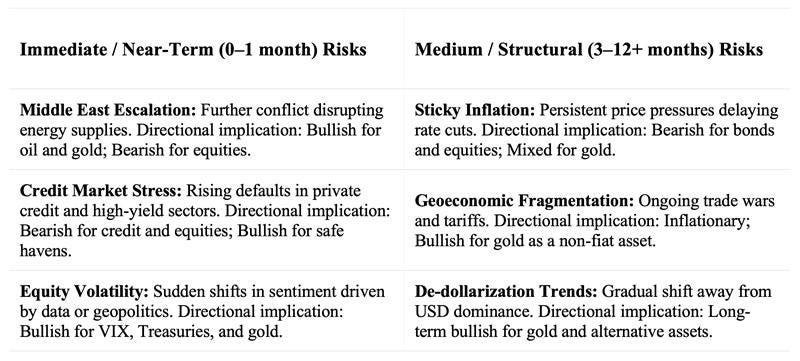
Risk Matrix Snapshot
Scenario Watch & Forward Catalysts
- US CPI Release (Mid-March): Base probability. A hotter-than-expected reading could reinforce the “higher for longer” narrative. Hawkish surprise = potential headwind to bullion.
- FOMC Meeting (Late March): Base probability. Market will closely parse the statement and dot plot for clues on the timing of potential rate cuts.
- Further Middle East Escalation: Elevated probability. Any disruption to energy infrastructure or broader regional conflict would drive significant safe-haven flows. Escalation = strong tailwind for gold and oil.
- Credit Event in High-Yield/Private Credit: Low-Probability Tail. A sudden spike in defaults could trigger a broader liquidity crisis. Credit event = strong tailwind for Treasuries and gold.
Portfolio Context & Implications
The current environment of heightened geopolitical risk, sticky inflation, and emerging credit stress underscores the importance of robust portfolio diversification. The traditional 60/40 portfolio faces challenges when both equities and bonds are vulnerable to inflation shocks. In this context, assets with low correlation to traditional financial instruments and proven safe-haven characteristics become increasingly relevant. The recent flight to safety, which saw simultaneous rallies in Treasuries and gold, highlights the market’s search for reliable stores of value amidst compounding uncertainties.
Precious Metals Strategic Thesis
Diversification Attribute
Precious metals, particularly gold, offer a critical diversification benefit due to their historically low correlation with equities and bonds. In periods of market stress or geopolitical turmoil, gold often moves independently of traditional risk assets, helping to smooth overall portfolio volatility.
Wealth Protection & Purchasing Power
Gold has a long-standing track record of preserving purchasing power over the long term. In an environment characterized by persistent inflation and fiat currency debasement, precious metals serve as a tangible store of value, protecting wealth from the erosive effects of rising prices.
Drawdown Mitigation & Crisis Optionality
During severe market drawdowns or systemic crises, gold frequently exhibits positive performance, providing a crucial buffer for portfolios. This “crisis optionality” makes precious metals an essential component of a defensive investment strategy, offering liquidity and stability when other assets falter.
Structural Demand Drivers
The strategic thesis for precious metals is supported by robust structural demand drivers. Continued accumulation by central banks seeking to diversify their reserves away from the US dollar, coupled with sustained investment demand via ETFs and physical bars/coins, provides a strong foundation for long-term price appreciation.
Allocation Framing
Academic research and historical performance suggest that a strategic allocation to precious metals can enhance the risk-adjusted returns of a diversified portfolio. While the optimal allocation varies based on individual risk tolerance and investment objectives, the inclusion of gold and other precious metals is widely recognized as a prudent measure for long-term wealth preservation and resilience.
Summary Capsule
- Macro Pulse: Mixed economic data with robust US growth overshadowed by sticky inflation and cautious central bank stances.
- Metals Stance: Gold remains highly resilient, supported by safe-haven demand, central bank buying, and ETF inflows amidst global uncertainty.
- Risk Tone: Risk-off sentiment dominates, driven by the severe escalation of the Middle East conflict and resulting energy supply fears.
- Positioning Nuance: Investors are aggressively hedging credit risk and seeking refuge in US Treasuries, driving yields significantly lower.
- Forward Watch: Markets are hyper-focused on geopolitical developments in the Strait of Hormuz and upcoming US inflation data.
- Structural Theme: The ongoing restructuring of global trade and the gradual shift towards de-dollarization continue to support the long-term case for non-fiat assets like gold.
Source List
[1] CNBC — PPI January 2026 — Feb 27, 2026 — https://www.cnbc.com/2026/02/27/ppi-january-2026-.html [2] KamakuraCo.com — SAS Weekly Treasury Simulation — Feb 27, 2026 — https://www.kamakuraco.com/sas-weekly-treasury-simulation-february-27-2026-3-month-bill-decline-stays-on-track-to-1-to-2-in-30-months/ [3] Understanding War — Iran Update Special Report — Feb 28, 2026 — https://understandingwar.org/research/middle-east/iran-update-special-report-us-and-israeli-strikes-february-28-2026/ [4] Reuters — Iran War: See How Tanker Traffic Collapsed Strait Hormuz — Mar 6, 2026 — https://www.reuters.com/world/middle-east/iran-war-see-how-tanker-traffic-collapsed-strait-hormuz-2026-03-06/ [5] PR Newswire — Manufacturing PMI at 52.4% February 2026 — Mar 2, 2026 — https://www.prnewswire.com/news-releases/manufacturing-pmi-at-52-4-february-2026-ism-manufacturing-pmi-report-302699883.html [6] FXEmpire — Platinum Historical Data — Mar 6, 2026 — https://www.fxempire.com/commodities/platinum/history [7] Federal Reserve — Recent Postings — Mar 6, 2026 — https://www.federalreserve.gov/recentpostings.htm [8] WSJ — Asian Currencies Consolidate — Mar 4, 2026 — https://www.wsj.com/finance/currencies/asian-currencies-consolidate-could-be-weighed-by-middle-east-conflict-f4e8c269 [9] Reuters — US Weekly Jobless Claims Unchanged — Mar 5, 2026 — https://www.reuters.com/world/us/us-weekly-jobless-claims-unchanged-layoffs-decline-55-february-2026-03-05/ [10] Kitco — Precious Metals Prices — Mar 6, 2026 — https://www.kitco.com/price/precious-metals [11] Investing.com — Crude Oil Historical Data — Mar 6, 2026 — https://www.investing.com/commodities/crude-oil-historical-data [12] Economic Times — Fed Rate Cut Outlook — Mar 6, 2026 — https://m.economictimes.com/news/international/us/fed-rate-cut-outlook-will-the-federal-reserve-hold-back-policy-rate-cuts-following-the-taylor-rule-as-signs-of-rising-inflation-fuel-the-us-stock-market-crash/articleshow/129155708.cms[13] BBC / Nippon.com — Central Bank Updates — Mar 6, 2026 — [Verification Needed — Aggregated from search summary] [14] Wolfstreet.com — Update on the Fed’s Balance Sheet — Mar 5, 2026 –https://wolfstreet.com/2026/03/05/update-on-the-feds-balance-sheet-and-its-reserve-management-purchases/ [15] BEA — GDP Advance Estimate 4th Quarter and Year 2025 — Feb 27, 2026 — https://www.bea.gov/news/2026/gdp-advance-estimate-4th-quarter-and-year-2025 [16] BLS — Consumer Prices Up 2.4 Percent — Feb 27, 2026 — https://www.bls.gov/opub/ted/2026/consumer-prices-up-2-4-percent-over-the-year-ended-january-2026.htm [17] Argus Media — Eurozone Manufacturing Expands in February — Mar 2, 2026 — https://www.argusmedia.com/ja/news-and-insights/latest-market-news/2794763-eurozone-manufacturing-expands-in-february [18] Yahoo Finance — Treasuries Regain Edge Safety Play — Mar 6, 2026 — https://finance.yahoo.com/news/treasuries-regain-edge-safety-play-100000753.html [19] FXStreet — Macrostructure Weekly Wrap — Mar 1, 2026 — https://www.fxstreet.com/analysis/macrostructure-weekly-wrap-dxy-yields-gold-and-crude-at-key-gates-202603011912 [20] Natural Gas Intelligence — Futures Settle Natural Gas Rallies — Mar 6, 2026 — https://www.naturalgasintel.com/news/futures-settle-natural-gas-rallies-back-above-3-on-war-risk-bullish-storage-draw/ [21] Kpler — US-Iran Conflict Strait of Hormuz Crisis — Mar 6, 2026 — https://www.kpler.com/blog/us-iran-conflict-strait-of-hormuz-crisis-reshapes-global-oil-markets [22] World Gold Council — Gold ETFs Holdings and Flows — Mar 6, 2026 — https://www.gold.org/goldhub/research/gold-etfs-holdings-and-flows/2026/03 [23] World Gold Council — Central Bank Gold Statistics — Mar 6, 2026 — https://www.gold.org/goldhub/gold-focus/2026/03/central-bank-gold-statistics-momentum-eases-january-while-demand-base [24] Yahoo Finance — Credit Markets Flash Warning Signs — Mar 6, 2026 — https://finance.yahoo.com/news/credit-markets-flash-warning-signs-112831728.html [25] GlobeNewswire — Credit Markets Flash Red — Feb 27, 2026 — https://www.globenewswire.com/news-release/2026/02/27/3246598/0/en/Credit-Markets-Flash-Red-Are-We-Repeating-the-Early-Mistakes-of-2008-Michael-S-Eisenga-CEO-First-American-Properties-provides-insight.html [26] CNBC — Stock Market Today Live Updates — Feb 26, 2026 — https://www.cnbc.com/2026/02/26/stock-market-today-live-updates.html [27] Yahoo Finance — VIX Historical Data — Mar 6, 2026 — https://finance.yahoo.com/quote/%5EVIX/history [28] Investopedia — Stock Market Today — Feb 27, 2026 — https://www.investopedia.com/stock-market-today-dow-jones-s-and-p-500-02272026-11915796 [29] PIIE — China No Longer Buys US Exports — Mar 6, 2026 — https://www.piie.com/blogs/realtime-economics/2026/china-no-longer-buys-us-exports-drawing-right-lessons-next-trump-xi [30] Al Jazeera — Russian Attacks on Kramatorsk Escalate Ukraine War — Mar 6, 2026 — https://www.aljazeera.com/news/2026/3/6/russian-attacks-on-kramatorsk-escalate-ukraine-war-as-kyiv-regains-ground [31] US News — Ukraine Returns 300 Soldiers in Second Day of POW Swaps — Mar 6, 2026 — https://www.usnews.com/news/world/articles/2026-03-06/ukraine-returns-300-soldiers-in-second-day-of-pow-swaps-with-russia-zelenskiy-says [32] Politico — NATO’s Ukraine Lifeline Hits a Production Wall — Feb 27, 2026 — https://www.politico.com/newsletters/national-security-daily/2026/02/27/natos-ukraine-lifeline-hits-a-production-wall-00804212 [33] Responsible Statecraft — How BRICS Will React to Trump — Mar 6, 2026 — https://responsiblestatecraft.org/how-brics-will-react-to-trump/ [34] International Banker — Global Trade Shifts Ahead in 2026 — Mar 6, 2026 — https://internationalbanker.com/finance/global-trade-shifts-ahead-in-2026/ [35] LinkedIn — Central Bank AI Cloud — Mar 6, 2026 — https://www.linkedin.com/pulse/central-bank-ai-cloud-anthropics-wealthtech-push-stack-pylarinou-bitle
Pending Verification: [13] Specific quotes and exact timing of BoE and BoJ statements regarding inflation targets and Middle East conflict impacts require primary source verification.
Methodology & Notes
Data was compiled using automated search and aggregation tools, focusing on credible financial news outlets, central bank publications, and market data providers. Price ranges and specific data points are approximated based on available reporting within the coverage window. The coverage period strictly adheres to the Friday 00:00:00 EST to Friday 11:00:00 EST timeframe, ensuring the inclusion of relevant Friday morning releases where available.
Disclosure
This report is for informational purposes only and does not constitute investment advice, a recommendation, an offer, or a solicitation to buy or sell any financial instrument. The views expressed are based on publicly available information believed to be reliable, but accuracy or completeness cannot be guaranteed. Past performance is not indicative of future results. Readers should conduct their own analysis and consult qualified professionals before making any financial decisions.
#WiseGold #Gold #PreciousMetals #MacroEconomics #GlobalMarkets #Geopolitics #WealthManagement #FinancialAdvisors #FamilyOffice #PortfolioStrategy #AlternativeAssets #CentralBanks #Inflation #EnergyMarkets #DollarDynamics #SafeHaven #FinanceNews #MarketIntelligence #WeeklyPulse